Once We’ve Manufactured Your Equipment, It Doesn’t Stop There.
Behind The Build
Once We’ve Manufactured Your Equipment… It Doesn’t Stop There
When people think about heavy engineering, they often picture fabrication bays, welders at work, and large stainless-steel vessels taking shape inside a workshop. That’s certainly part of what we do but it’s only part of the story.
manufacturing bespoke equipment is just one stage in a much wider, carefully controlled service. From early design through to final installation on site, every project is supported by extensive planning, training, qualification and coordination, much of which happens quietly behind the scenes.
Engineering Beyond the Workshop
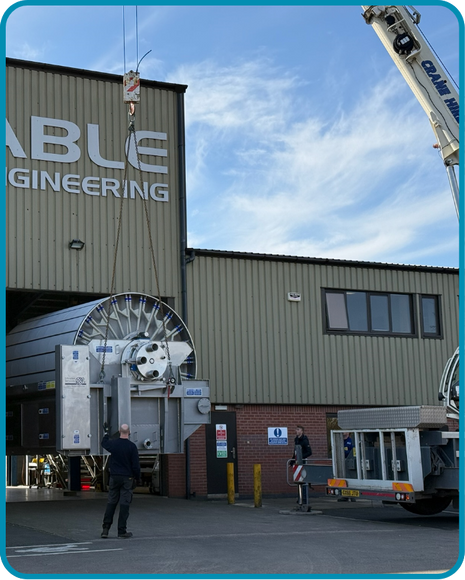
Large-scale equipment brings large-scale responsibility. Once fabrication is complete, attention immediately turns to how that equipment will be moved, transported, installed and commissioned safely.
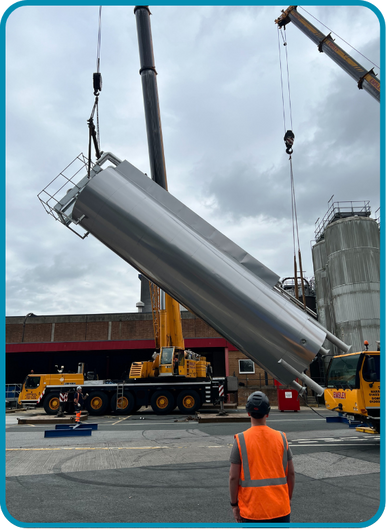
Before large vessels ever leaves our site, detailed lift planning is carried out. This includes assessing weight, centre of gravity, lifting points and crane requirements, alongside comprehensive risk assessments tailored to the specific lift and environment.
Our teams are trained accordingly. Banksman training ensures that lifting operations are controlled, clearly communicated and carried out safely, while crane coordination training ensures all parties involved understand their responsibilities during complex lifts.
Training, Qualifications and Specialist Expertise
Behind every project is a workforce whose skills are continually maintained and updated. All welding is carried out by coded Tradespeople, with qualifications kept fully up to date to meet relevant standards and client requirements. Ongoing training ensures our team remains current with best practice in hygienic fabrication, pressure systems, structural integrity and process engineering.
Beyond welding, our engineers bring specialist expertise in process design, allowing equipment to be manufactured not just to fit physically, but to perform reliably within complex industrial systems. This commitment to training and competence ensures that quality, safety and compliance are built into every stage of a project.
Installation and Site Readiness
Installation planning begins long before equipment arrives on site. We assess access constraints, lifting requirements, existing infrastructure and interface points to ensure the installation can be completed efficiently and safely. By understanding the site environment in advance, we reduce downtime, avoid last-minute changes and help our clients transition smoothly to new equipment.
Logistics, Transport and Coordination
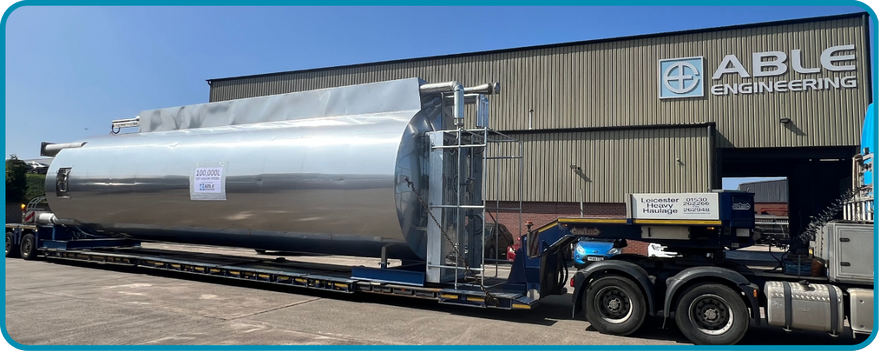
Moving oversized equipment is a project in its own right. For wide or abnormal loads, we work closely with specialist haulage partners, traffic police and local authorities to ensure routes, timings and permits are correctly planned. This coordination is essential to minimise risk to the public, infrastructure and the equipment itself.
Vessels are carefully secured and protected for transport, whether travelling by road or as part of an international delivery. Export documentation, delivery sequencing and site access planning are all managed to ensure the equipment arrives ready for installation, not delayed or compromised by avoidable issues.
Why the Details Matter
At this scale, there is no margin for error. A missed detail during transport planning, an overlooked training requirement, or an assumption made during installation can have serious consequences. That’s why Able Engineering treats logistics, safety and coordination as integral parts of the engineering process.
End-to-End Engineering, Done Properly
Engineering doesn’t end when the last weld is completed. For us, that’s often when the most critical work begins, ensuring that what we’ve built arrives safely, installs correctly, and performs exactly as intended in the real world.
It’s this combination of technical capability, rigorous training, and disciplined planning that allows Able Engineering to deliver complex, oversized equipment with confidence, from workshop floor to operational site.
Because building it is only part of the job. Delivering it properly is what makes the difference.